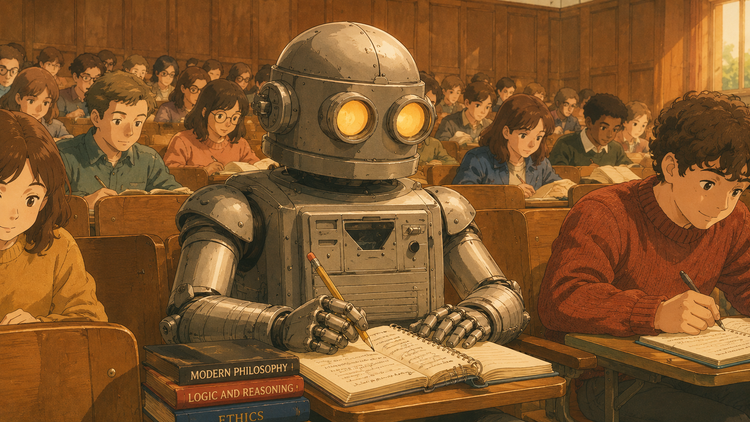
What can humans do that AI can't?
This question gets asked a lot because people feel threatened by AI.
There are days where I wonder about the future of my career due to AI. I’m a principal level engineer and I’ve fully converted to agentic development. Anthropic recently released a labor market impact report that suggests wide impacts to knowledge workers that are yet to be fully realized.
There are two compelling answers that often get floated:
- Humans can decide what to do.
- Humans have taste.
To me, these are the same answer. People often think of taste as this sense of good and bad. But really it’s about making the right decisions for the given context. It’s deciding what to do.
But, why can’t AI do this?
Agents make many decisions given the context of a prompt. It has taste. I’ve seen it take a single prompt and make reasonable applications. I’ve seen it make beautiful user interfaces.
The element of decision making AI doesn’t have is initiative. AI requires a directive to do anything. AI isn’t actually embedded in the world in any meaningful way. It can churn out ideas. But those ideas are not driven by lived context within the world. They certainly are coming solely from the AI.
Along with this AI has no continuity. I’ll be working with a coding agent for a while and suddenly it’ll forget critical details. This will get better but continuity is not just about memory. Every call to the LLM has to include context or it’s a fresh start. That context has to be managed. AI isn’t an entity embodied through time. We just use it to try to simulate that.
I see taste as a form of critical decision making. However, it goes beyond what AI is capable of currently. Human preferences are not just conceptual ideas embedded in language. Nor are they limited to sound and image. We are capable of processing experiences that combine all the sense and deciding if they feel right. Emotion is a critical aspect of taste that AI is not fully capable of appreciating.
I’ve mostly agreed with the common answers, though the reality is more specific than just taste and decision making. Human differentiation lives in nuanced aspects of those things, not the capabilities in themselves.
There are a couple human behaviors that AI is even weaker at.
- Humans can be surprised and surprising.
- Humans can be irrational.
LLMs are an averaging of many human outputs. They rarely give surprising answers. But humans can be very divergent from each other. And themselves over time.
You can introduce chaos factors into AI but there’s something different here. Humans can be surprising but internally consistent. When we try to get surprising answers from an LLM it tends to feel random.
Related to this is irrationality. The more knowledge used to train LLMs the more rational they tends to be. The ability to reason is essentially the goal of larger and larger models.
Sometimes we need something other than rationality.
Irrational answers are frowned upon. But, humans aren’t really rational. We have emotions and instincts. We need things to feel right instead of just being right. AI can rationalize an answer but isn’t equipped with the empathy required for correct irrational answers.
So then, what is the answer?
AI can simulate human thinking to a remarkable degree.
Yet, humans have to embody their decisions and the consequences. Humans grow and continue in a way that AI cannot. AI can mirror this but never truly be it.
We want a clear, certain answer to this question. We want to be able to say focus on this and your career is safe from AI.
Humans are fuzzy and so is AI. The answer has to be fuzzy too.
There’s a lot of overlap but taking the initiative to worry about a problem like this is something only humans can do.